
Moving into a 1930s deco walk-up: carrying it up the stairs
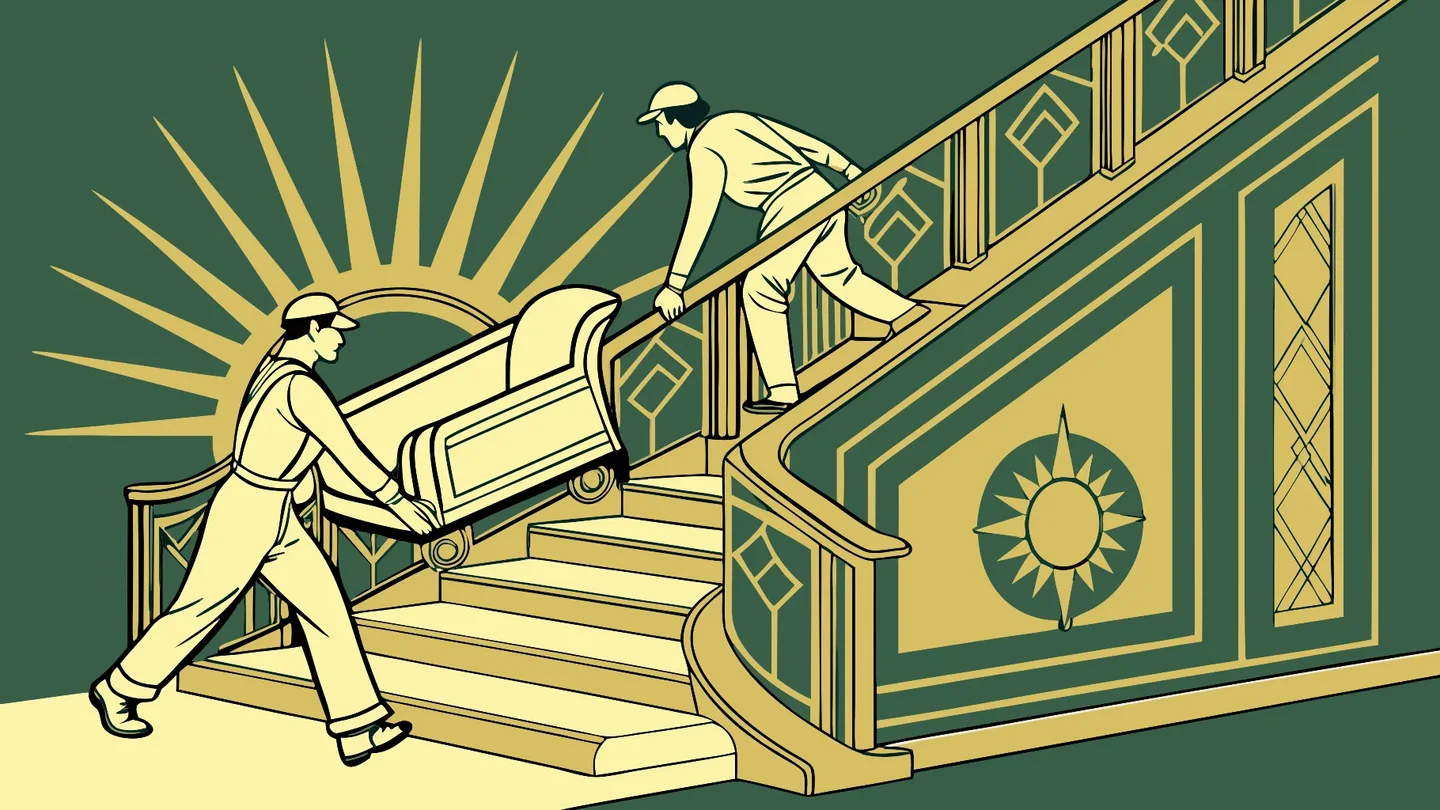
There is a stretch of the inner city — Potts Point, Elizabeth Bay, the older parts of Darlinghurst — that holds one of the best collections of 1930s Art Deco apartment blocks in Australia. They are beautiful: mosaic-tile foyers, brass and amber glass, sunburst balustrades. They were also built in an era that designed for people, not trucks — and that is the whole story of moving into one.
The buildings were never built for moving day
Take Birtley Towers in Potts Point, an Emil Sodersten block from 1934: 54 flats over nine floors, and just 14 car spaces. That ratio tells you everything. Loading access was simply not a design priority in the 1930s. The streets are narrow and tree-lined, the kerbs are tight, and the buildings sit right up against the footpath. So the first thing a good city mover does is plan the truck around the street, not the other way around.
Lift or no lift? Read the building first
Not every deco block is the same. The grand blocks often have a lift, and sometimes a dedicated service lift — Macleay Regis in Elizabeth Bay, completed in 1939, was the largest block of flats in Sydney when it opened and had service lifts feeding every floor. But many of the smaller inter-war walk-ups have no lift at all. In those, every single item is carried up the stairs, and the stairs are the job.
That is why we read the building before we quote. If there is a usable service lift, we book it. If there is not, we plan a stair carry — and a deco stair carry has its own quirks.
Measure the stairwell turns
Deco stairwells are often gracious to look at and awkward to move through: tight turns, half-landings, and balustrades you absolutely do not want to scratch. The single most useful thing you can do before move day is measure the turns and landings — the point where a wardrobe or a sofa-bed has to pivot is where a move either flows or stalls. We do this as standard, because a piece that will not make the turn is better known in advance than wedged on a landing.
Protect the heritage finishes
Mosaic-tile floors, brass handrails, original timber and that amber glass are part of why people love these buildings — and part of why a careless move is expensive. We bring stair-protection and corner padding, run the carry on a planned path, and treat the common areas as carefully as your own things. In many of these blocks the strata also wants a certificate of currency for the movers’ public-liability cover before the move.
Plan for fewer trips, carried well
A no-lift walk-up rewards good packing. Well-packed, well-labelled cartons that a person can carry safely up four flights beat a heroic single trip with an overloaded box every time. Tell us the floor and the building and we will bring the right crew size so the carry is steady, not a scramble.
The short version
Moving into a deco walk-up is a carry, not a kerb job. Read the building, measure the stairwell turns, protect the finishes, and bring enough crew to do it calmly. If you would like us to plan it, get a quote or find your suburb — Potts Point, Elizabeth Bay and Darlinghurst all have their own access notes.
General guidance, current June 2026. Building histories: Birtley Towers (1934) and Macleay Regis (1939) per published Potts Point / Elizabeth Bay architectural records. Lift availability varies block to block — we confirm yours before the move.
Planning a move?
Get a free, no-obligation quote and we'll plan the access at both ends with you.
Get a quote